
Andalusia will establish a major air quality monitoring site at the IISTA-UGR, in compliance with new European regulations.
Andalusia will establish an urban background "super-site" to monitor air quality at the Interuniversity Research Institute for Earth System Science in Andalusia (IISTA) at the University of Granada, in compliance with the new European Air Quality Directive. The selection of the IISTA is due to its status as a national facility within the ACTRIS (Aerosols, Clouds and Trace Gases Research Infrastructure) ERIC—a network in which it participates through the Andalusian Global Atmospheric Observatory (ÁGORA), with monitoring stations located both at the institute itself and in the Sierra Nevada.
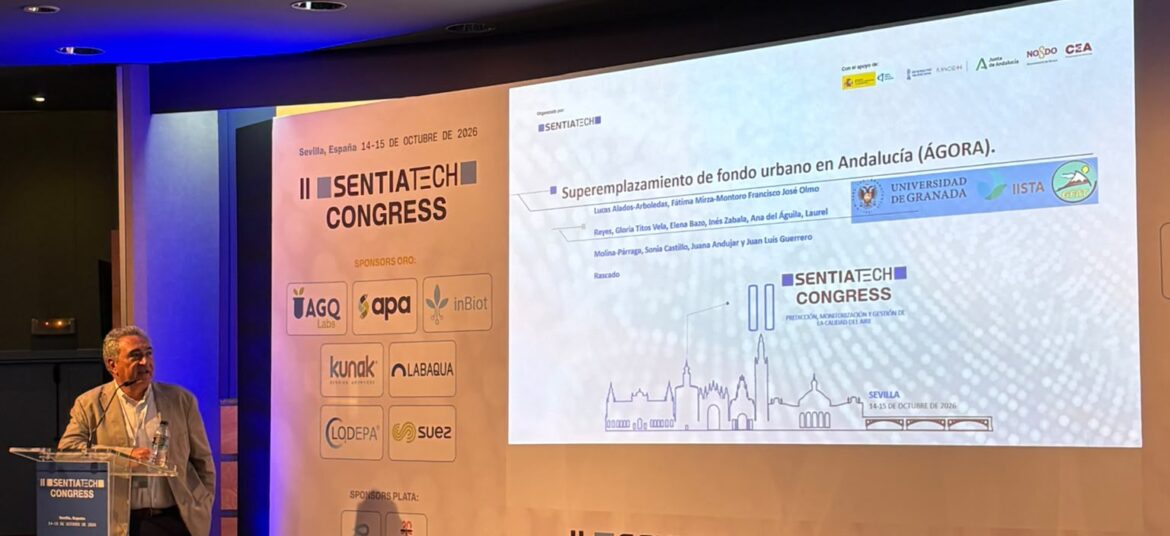
Oral presentation delivered by Lucas Alados Arboledas—Professor of Applied Physics at the University of Granada (UGR) and coordinator of the Atmospheric Physics Group (GFAT)—at the 2nd SENTIATECH Congress, held on October 14–15, 2026, in Seville. Organized by the SENTIATECH Technology Platform at the headquarters of the Confederation of Entrepreneurs of Andalusia (CEA), the event brought together the research community, technology companies, and public authorities to address air quality prediction, monitoring, and management. The GFAT participated in its capacity as a national facility for ACTRIS.
A new concept in European regulation
The super control sites (supersites) They are one of the new features of Directive (EU) 2024/2881, The new regulation aligns European air quality standards with WHO recommendations and sets a zero-pollution target for 2050. It involves urban and rural background monitoring stations that combine multiple sampling points to collect long-term data on pollutants—such as ultrafine particles (including their size distribution) and black carbon—that are of growing concern due to their health impacts, yet for which legal limits do not always exist.
The Directive requires at least one urban "super-site" for every ten million inhabitants; this site must be representative of the exposure of the general urban population and reflect the mix of all pollution sources within the city, without any single source dominating. The data collected serve four strategic objectives: studying the health impacts of ultrafine particles and black carbon; establishing background levels and distinguishing the origins of pollution; identifying sources through chemical speciation; and calibrating photochemical prediction models. Furthermore, these data will support periodic reviews of the standard—the first of which is due before 2030—and must be coordinated with European scientific programs such as EMEP and ACTRIS. Surface-level data are also used to calibrate and validate Earth observation products from the Copernicus program.
Granada, home to the major Andalusian hub
The Regional Government of Andalusia (Junta de Andalucía) has proposed to the Ministry for the Ecological Transition and the Demographic Challenge (MITECO) that the region’s "urban background super-site" be located at the Global Atmosphere Observatory of Andalusia (ÁGORA)—a unique research facility based at the IISTA (Institute for Research on Earth System Sciences) at the University of Granada (UGR). ÁGORA comprises an urban station in the valley (UGR, 660 m) and a mountain station in the Sierra Nevada (SNS, 2,510 m), situated 22.5 km apart. The IISTA site provides in-situ aerosol measurements as well as remote sensing of aerosols and clouds, while the Sierra Nevada site provides in-situ measurements of both aerosols and clouds. Furthermore, the observatory operates within the European research networks ICOS and LifeWatch.
The future "super-site" builds upon a solid foundation: over ten years of aerosol data. Particle size distribution has been measured since 2015—and, as of December 2023, using an SMPS covering the 10–800 nm range. The absorption coefficient has been measured using an MAAP photometer since 2007 and aethalometers since 2012. The AE33, in operation since 2013, incorporates a real-time source-apportionment algorithm that distinguishes between biomass burning and fossil-fuel combustion; as of 2026, this is complemented by a nine-wavelength AE36. Observations at the super-site will be supplemented by the institute’s atmospheric remote-sensing data, adding an extra dimension.
The presentation also included previous studies conducted by the group in the city. Among these, a 2014 study on transport-related changes showed a 37% reduction in soot (eBC) and a 33% reduction in PM10 within the central area, with no significant effects observed outside of it. Another study, which examined sources of particulate matter, attributed 64% of PM1 in winter to traffic, and found that mineral-based sources accounted for 45% of PM10 in the summer.
Other contributions from the GFAT
The group contributed three other presentations to the conference. Fátima Mirza Montoro presented an analysis of a decade of eBC (equivalent black carbon) data from the ÁGORA network, employing source apportionment to distinguish between black carbon originating from fossil fuels and that from biomass burning. Juana Andújar Maqueda showcased the use of Doppler Lidar to generate maps of estimated PM10 levels in Granada; when combined with data from a reference station, this approach allows for the observation of spatial aerosol variability and the monitoring of areas of interest without the need for fixed equipment. Finally, Laurel Molina Párraga presented an artificial intelligence model capable of predicting air quality three days in advance for several Spanish cities. The model’s performance and transferability are evaluated and compared against CAMS (Copernicus Atmosphere Monitoring Service), representing a step toward an operational alert system for the general public and public authorities.
The group also presented the poster. "Can remote sensing measurements help in understanding air quality?", signed by Sonia Castillo, Gregori de Arruda Moreira, Francisco José Olmo, Fátima Mirza Montoro, Gloria Titos Vela, Laurel Molina Párraga, Juan Luis Guerrero Rascado, Juana Andújar Maqueda, Pablo Ortiz Amezcua, and Lucas Alados Arboledas.
The work is the result of the entire team’s effort, which also includes Alberto Cazorla Cabrera, Elena Bazo, Inés Zabala, and Ana del Águila.
More information: II SENTIATECH Congress – ACTRIS National Facilities